Protecting Export Margins: Use primary data for CBAM reporting

EXECUTIVE SUMMARY:
As the European Union’s Carbon Border Adjustment Mechanism (CBAM) moves from transitional reporting to actual financial levies, industrial leaders in the foundry and forging sectors face a critical choice. They can either accept the “Default Values” provided by EU authorities—which act as a heavy, punitive tax—or they can leverage their own Primary Data to protect their margins. For a mid-sized company, the difference between these two paths is the difference between negative margins and a profitable export business.
THE CBAM CHALLENGE: MARGIN PRESSURE
The CBAM regulation requires non-EU exporters of steel products to report the Greenhouse Gas (GHG) emissions embedded in their goods. The importer must purchase certificates to cover these emissions, effectively creating a “Carbon Tax” at the border.
The EU allows two methods for reporting:
Default Values: A “country-wise” number based on the worst-performing producers.
Primary Data: Actual, verified data from your specific furnaces, energy mix, and raw material supply chain.
THE “DEFAULT VALUE” TRAP: THE ARITHMETIC OF AVOIDABLE LOSS
The EU’s default values are intentionally high to encourage companies to report actual data. Relying on defaults is equivalent to paying a premium on every ton of metal shipped. Consider a company exporting 10,000 tonnes of steel components to the EU annually.
- Average Carbon Price: $90 (₹ 8100)/ tonne of CO2.
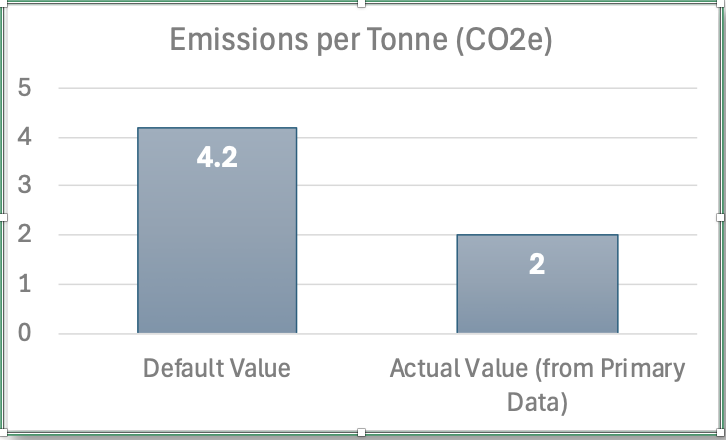
- The Default Penalty: EU assumes a high emission factor (e.g., 4.2 CO2e / tonne of product).
- Primary Data Advantage: Your steel suppliers actually operate at about 2.0 CO2e / tonne.
| Metric | Using Default Values | Using BACUTI (Primary Data) |
| Emissions per Tonne | 4.2 t CO2e | 2.0 t CO2e |
| Total Carbon Liability | 42,000 t CO2e | 20,000 t CO2e |
| Annual CBAM Cost ($) | $3,780,000 | $1,800,000 |
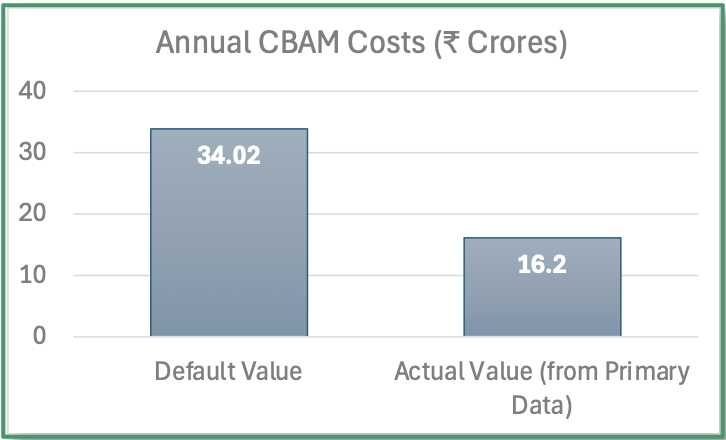
| Annual CBAM Cost (₹) | ₹ 34.02 Crores | ₹ 16.2 Crores |
| NET SAVINGS (₹ Crores / year) | ₹ 0.00 Crores / year | ₹ 17.82 Crores / year |
In this scenario, primary data reporting saves the company ₹ 17.82 Crores ($1.98M) / year.
 |  |  |
IMPACT ON EXPORT MARGINS
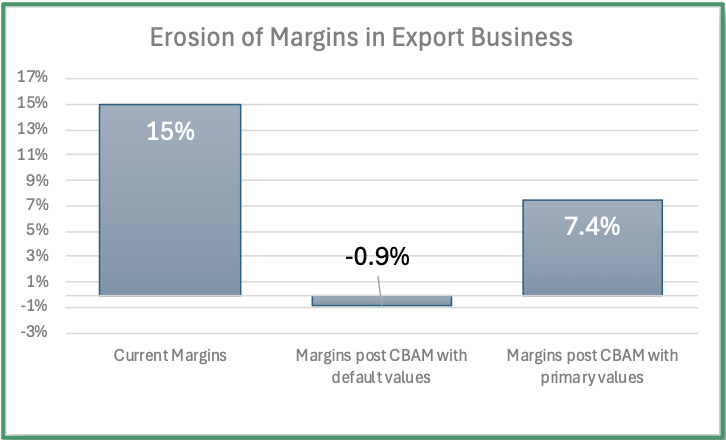
While some of the burden of the CBAM costs may be borne by the importer, a huge fraction of the CBAM burden falls on the exporter. In our experience, 70% of this cost falls on the exporter. A mid-size company exporting 10,000 tonnes of steel products at ₹ 150/ kg making 15% margin will see their margins erode to -1 % if they use default values. Using primary data for CBAM reports can improve the margin to over 7%.
BEYOND SAVINGS: THE STRATEGIC UPSIDE
Using primary data offers three distinct competitive advantages:
- Market Share Expansion: When your carbon footprint is lower than the “Default” or your competitors’ footprints, your product becomes cheaper for the EU importer. You become the preferred supplier not just on quality, but on “Carbon-Adjusted Price.”
- Operational Intelligence: Primary data collection reveals where your energy is being wasted. By identifying “hot spots” in your process, you can reduce energy consumption, lowering both your carbon tax and your utility bills simultaneously.
- Lower Cost of Capital Global banks are increasingly linking interest rates to “Green Performance.” By providing verified, primary carbon data, your enterprise presents a lower risk profile to lenders and investors.
THE SOLUTION: BACUTI
BACUTI platform is specifically designed for the complexities of the metals and manufacturing industries.
- Actual primary data from large steel suppliers: Don’t pay the default penalty.
- Automated Data Capture: Stop relying on messy spreadsheets.
- Audit-Ready Reports: Generate CBAM-compliant reports at the click of a button.
CONCLUSION
Carbon is no longer just an environmental metric—it is a financial one. Continuing to use default values is a choice to overpay. By adopting a primary data strategy today, you protect your margins, win EU market share, and future-proof your business against evolving global regulations.