Sustainability Regulations Landscape
BACUTI’s annual report on Sustainability Regulations Landscape – Edition 2

The past year, 2024–2025, brought massive, rapid changes to the rules about telling the world how sustainable a company is. This has created a real challenge for manufacturing companies globally. We saw a complicated mix of governments either pushing forward with strict new rules or actually backing away from old ones. This means there's no single, easy playbook anymore; companies must deal with a confusing patchwork of different requirements based on where they operate. For example, the European Union is going full speed ahead with big plans like the Corporate Sustainability Reporting Directive (CSRD) and the Carbon Border Adjustment Mechanism (CBAM), while the U.S. has hit the brakes on its major federal climate disclosure rules. This split forces global manufacturers to be incredibly strategic, juggling local compliance needs while trying to keep their entire supply chain running smoothly.

The biggest game-changer is that it’s no longer about voluntarily being green; it's about mandatory financial consequences for how much carbon you produce. New carbon pricing systems, like the EU's CBAM and the UK's planned parallel system starting in 2027, are fundamentally changing international trade. If you import carbon-intensive products into the EU, you'll soon face direct costs. At the same time, major markets in Australia, the EU, and the Middle East are demanding much more detailed and transparent sustainability reports. For manufacturers, the key to winning is to build flexible, scalable systems that can handle all these diverse rules while constantly improving actual environmental performance. It's a new world where you must genuinely transform your business—from supply chain design to operations—to stay competitive.
CSRD
Corporate Social Responsibility – What is it and why is it important?

The Corporate Sustainability Reporting Directive (CSRD) is a new piece of legislation in the European Union which requires companies to report on their greenhouse gas emissions on all levels.

The CSRD, was passed to replace the NFRD. Concrete emissions data will be the primary focus of CSRD disclosures, Notably, CSRD will require a double materiality (both financial and impact materiality) assessment, not only requiring an evaluation of potential internal financial impacts, but larger societal impacts as well, both positive and negative.

The specificity of scope 3 emissions required by CSR requires a highly complex assessment of associated emissions of each individual product.

While the NFRD applied to about 11,000 companies in Europe, the CSRD will eventually impose reporting mandates on roughly 40,000 EU companies, as well as 10,000 non-EU companies. Of the non-EU companies, about 3,000 are based in the US, as well as 1,000 each in the UK and Canada.

Unlike NFRD, CSRD requires that companies have their reports audited and verified by an accredited independent certifier.
LESS
Understanding Low Emission Steel Standards

The Low Emission Steel Standard (LESS) is a new German certification standard that will provide a method for steel companies to disclose the sustainability status of their steel production. Certification will begin for companies in Q3 of 2024 and will require in-depth evaluation and reporting of product-level (scope 3) greenhouse gas emissions.

LESS stands for Low Emission Steel Standard. It’s a voluntary labelling program that classifies steel based on the carbon di oxide emissions released during pre-production and production of steel.

LESS certification is optional for companies, but highly recommended. LESS will apply to each of the two major methods of steel production: blast furnace production, and electric production. This will provide for simplified comparability of the two methods.

LESS utilizes a six-stage classification system which designates individual products a label of “near-zero” or a letter grade, A to E.
CBAM
Carbon Border Adjustment Mechanism – What Exporters should know
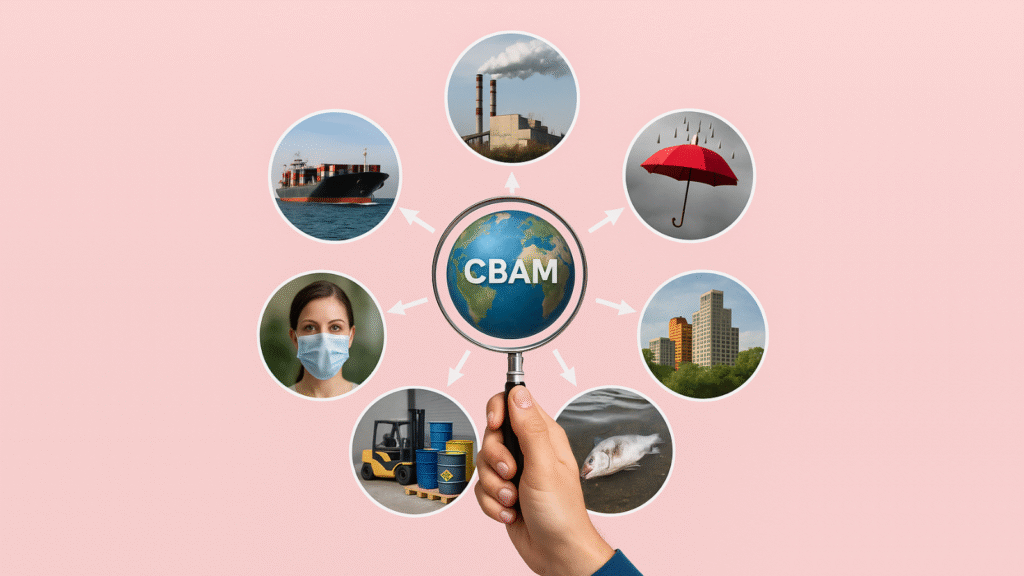
The Carbon Border Adjustment Mechanism (CBAM) is a carbon border tariff introduced by the European Union beginning Oct 2023. It will initially tax imports of products in the six most carbon-intensive sectors: aluminum, iron/steel, cement, electricity, hydrogen, and fertilizers on their embedded carbon content.

It is critically important that companies remain in-line with CBAM’s reporting guidelines for numerous reasons, extending beyond corporate transparency. First and foremost, failure to correctly report emissions accurately can incur a fine from the National Competent Authority of €10 to 50 per tonne of unreported emissions. Misreporting less than 1% of total emissions could result in fines amounting to several million euros per year for many of Europe’s medium and large companies.

If emissions associated with imported products and materials are unreported or misreported, the fifth-percentile default numbers will be applied potentially impacting the reputation of that company among consumers and investors.

Thirdly, noncomplying companies are at risk of having their CBAM licenses withdrawn, disallowing the importing of CBAM goods entirely.

Due to the novelty of the regulation and the stringency of its reporting requirements, penalties will not be applied liberally for the initial reporting periods. This increased flexibility will no longer be allowed for the 2024 Q3 reporting period.
Sustainability Regulations Landscape
BACUTI’s annual report on Sustainability Regulations Landscape – Edition 1
In the 21st century, as climate issues become more prevalent on a global scale, environmental impact has become a new component of corporate responsibility. Sustainability and carbon neutrality have become fundamental goals of governing bodies. In the United States, European Union, United Kingdom, and Asia, many new regulations’ ESG reporting requirements are coming into effect over the next several years. These regulations are often staggered in accordance with various scopes of emissions.

A substantial amount of ESG regulations worldwide will take effect by 2026, thus companies must adequately prepare to conduct sustainability evaluations and reporting with the necessary frameworks and standards. This document outlines a selection of the most important current and upcoming sustainability regulations that will affect companies during the next five years, as well as the types of companies affected, timelines of implementation, and the necessary reporting frameworks of each regulation.
SB-253 and SB-261
Undestanding California’s SB-253 and SB-261 regulations

On October 7, 2023, California passed the Climate Corporate Data Accountability Act (CCDAA) and the Climate-Related Financial Risk Act (CRFRA), the most extensive climate disclosure laws in the United States. Now, other major states like Illinois and New York are set to follow suit with their own climate disclosure regulations.

The package is comprised of Senate Bill 253 (CCDAA) and Senate Bill 261 (CRFRA), which were signed into law as a package by Governor Gavin Newsom. These bills impose sweeping sustainability requirements on businesses operating in California which will come into effect in phases over the next several years. SB-253 is primarily concerned with mandating intensive reporting of greenhouse gas (GHG) emissions, both directly and indirectly associated with a company. SB-261 requires disclosure of climate-related financial risks. Both regulations will be administered and enforced by the California Air Resources Board (CARB).

The Climate Corporate Data Accountability Act imposes a slew of sustainability reporting requirements on companies which will come into force soon. Medium to large businesses conducting operations in the United States must be aware of a multitude of upcoming regulations on the federal and statewide levels. Companies must be adequately prepared to disclose their climate data and product-level greenhouse gas emissions. However the calculation and reporting of product-level, scope 3 emissions pose a significant challenge that must be swiftly addressed.
Responsible Growth
A practical approach to implementing your sustainability strategy

In an era where sustainability is no longer optional but a business imperative, Bacuti presents a comprehensive approach to integrating sustainability into corporate operations. This white paper, "Responsible Growth: A Practical Approach to Implementing Your Sustainability Strategy," outlines the critical need for businesses to adopt sustainable practices driven by market forces, regulatory pressures, and the increasing demand from consumers and investors.

In this context, Bacuti's solution addresses the limitations of current bespoke approaches by offering a software-centric, scalable, and integrated platform. This platform simplifies data collection, integrates with supplier networks, and provides robust tools for planning, forecasting, and reporting. By leveraging Bacuti's innovative approach, companies can transition from setting ambitious sustainability goals to executing them effectively, ensuring responsible growth and a cleaner planet.