Union Budget 2026-27: Implications for Manufacturers, Exporters, and Sustainability Leaders
The 2026 Union Budget has fundamentally rewritten the “Rules of the Game” for Indian industry around sustainability. We are moving from a regime of voluntary efficiency to one of mandatory carbon accountability and “Green” financial incentives.
Here are some key takeaways for every executive leader in the manufacturing and export space:
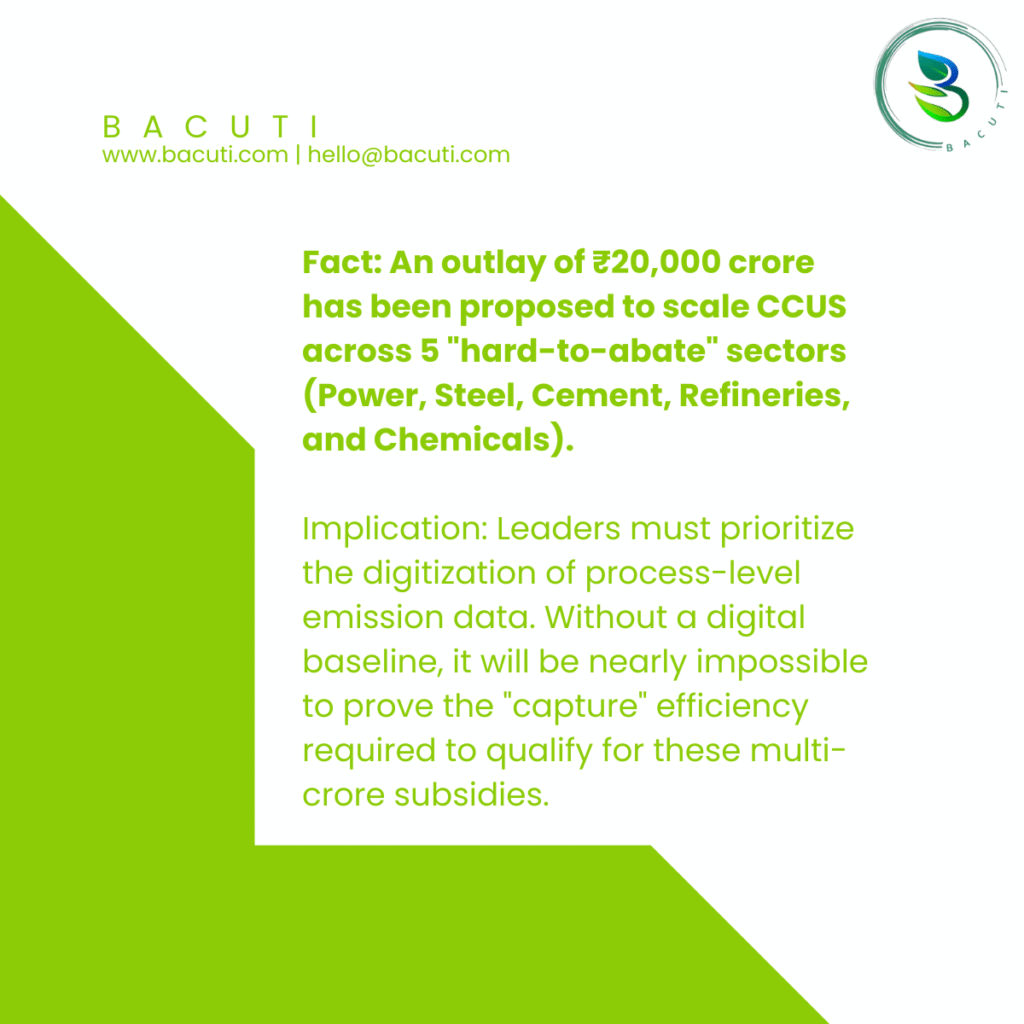
Fact:
An outlay of ₹20,000 crore has been proposed to scale CCUS across 5 “hard-to-abate” sectors (Power, Steel, Cement, Refineries, and Chemicals).
Implication for Executives:
If you operate in these sectors, begin feasibility studies for CCUS integration now; early adopters will likely benefit from the first wave of government subsidies and technology transfers.
Digitization implications:
Leaders must prioritize the digitization of process-level emission data. Without a digital baseline, it will be nearly impossible to prove the “capture” efficiency required to qualify for these multi-crore subsidies.
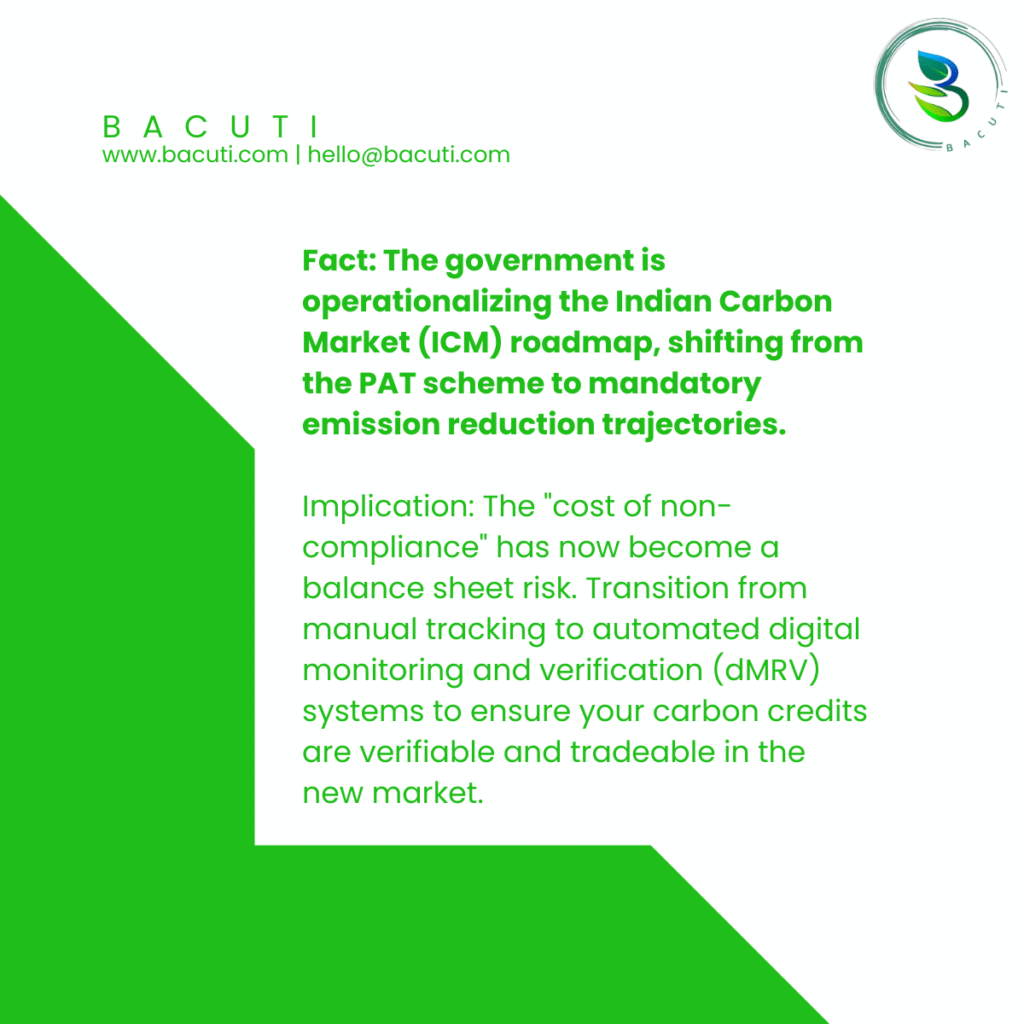
Fact:
The government is operationalizing the Indian Carbon Market (ICM) roadmap, shifting from the PAT scheme to mandatory emission reduction trajectories.
Implication for Executives:
Move beyond manual spreadsheets for carbon tracking. Invest in “audit-ready” sustainability software to ensure your emission data is verifiable for the upcoming mandatory compliance cycles.
Digitization implications:
The “cost of non-compliance” has now become a balance sheet risk. Transition from manual tracking to automated digital monitoring and verification (dMRV) systems to ensure your carbon credits are verifiable and tradable in the new market.
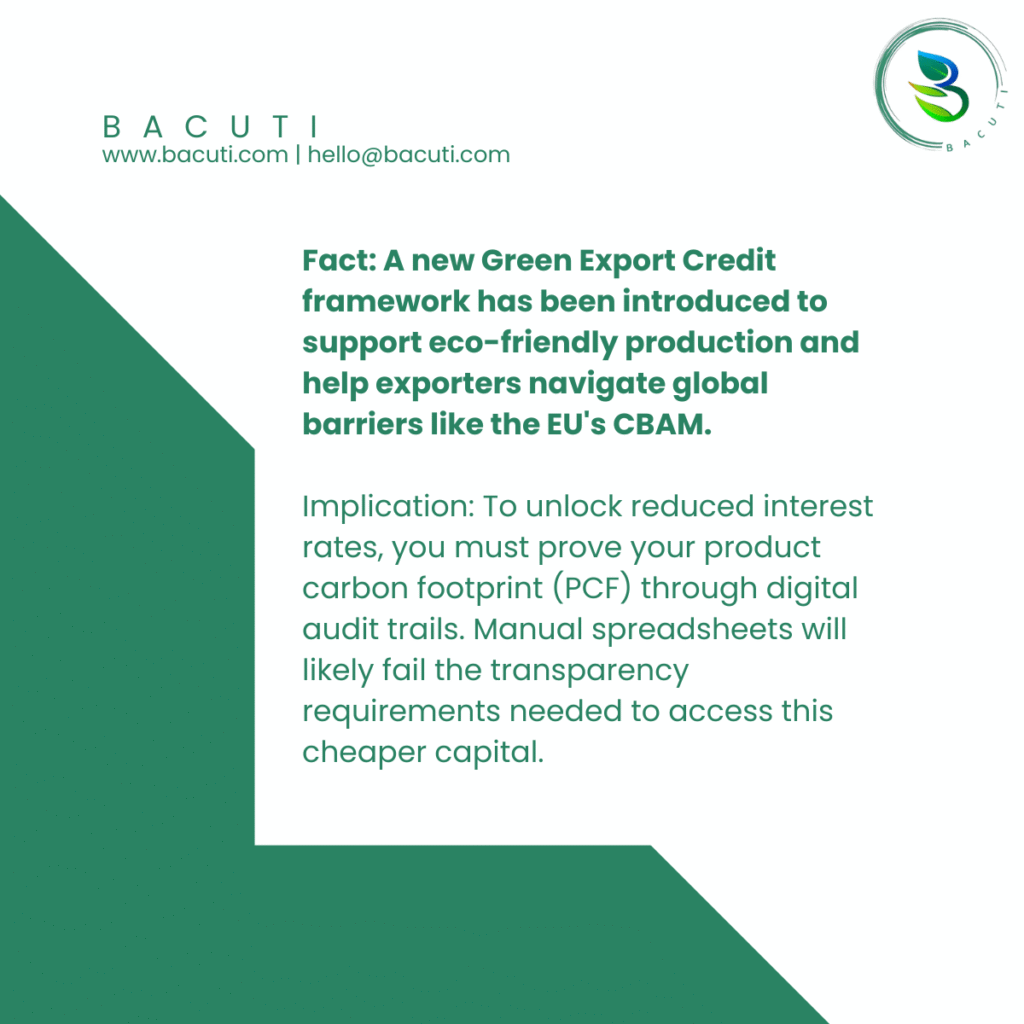
Fact:
Fact: A new Green Export Credit framework has been introduced to support eco-friendly production and help exporters navigate global barriers like the EU’s CBAM.
Implication for executives:
Implication: CFOs should work with Sustainability heads to document the “Green” credentials of export products. This verified data can now be leveraged to negotiate lower interest rates and higher credit limits with banks.
Digitization implications:
Implication: To unlock reduced interest rates, you must prove your product carbon footprint (PCF) through digital audit trails. Manual spreadsheets will likely fail the transparency requirements needed to access this cheaper capital.
Fact:
The Tex-Eco Initiative was launched to align the Indian textile value chain with international environmental standards.
Implication for Executives:
Textile leaders must implement traceability across their supply chain. Certification of sustainable practices is no longer a “nice to have”—it is now a prerequisite for participating in the new Mega Textile Parks.
Digitization implications:
CEOs must implement digital traceability across the supply chain. Proving “sustainable origin” via digital certificates is now a prerequisite for participating in the new Mega Textile Parks and avoiding export rejection.
The Bottom Line: The budget reward is for those who can prove their sustainability. Digitization of environmental data is no longer a “back-office task”—it is your most critical financial and strategic asset for the next decade. To learn more about how BACUTI can help, visit our “product page” or get in touch with us using the “contact” page